

IT company valuation starts with profit, not revenue. Buyers take EBITDA after paying the owner a fair salary, apply a multiple, then adjust it for how much revenue repeats every month and how much of it hangs on a single client. In one worked example, a $1 million MSP with 30% margins would sell for $1 million to $1.5 million (MSP podcast on selling to private equity). Roughly one year of revenue.
Most MSP owners carry a different number in their head. Usually it came from revenue, or from a multiple someone mentioned at a conference.
The gap between the two numbers can be brutal. One MSP coach says owners hear 10x and 12x thrown around, plan on getting $5 million, and find out the best offer on the table is $2 million.
Here's how buyers get to their number, and which parts of it you can move this quarter.
Buyers start with EBITDA, not revenue
MSPs are traded on multiples of EBITDA. Robin Robins makes the point in a session on MSP metrics. Revenue size matters because bigger firms get better multiples, but the price starts from your EBITDA.
So the first question is what your EBITDA really is. That means profit after you pay yourself a fair market salary. Not after the $40,000 you actually take. One benchmark calls 10% net EBITDA the new break-even once a fair salary is paid, with 10 to 20% as the range to aim for.
If you run lean on your own pay, a buyer will put a real salary back in as a cost. The profit you thought you had shrinks before any multiple touches it.
Take a worked example from an MSP podcast on selling to private equity. A $1 million MSP running 30% margins has about $300,000 of EBITDA. Their estimate of what someone would pay for it is $1 million to $1.5 million. Roughly one year of revenue, for margins most owners would be happy with.
Growth sits on top of all this. Robins describes a $2 million MSP at 10% EBITDA that isn't growing as not a bad business, but not one private equity will pay up for. Investors want a return, and a flat company makes them do the work to get it. A buyer pays more for a business that is already adding clients every month.
A dollar of recurring revenue is worth more than a dollar of projects
Buyers don't price every dollar the same. In the same Robin Robins session, $1 million of recurring service revenue is worth about $1.5 million to a buyer. $1 million of PC and server sales gets a check for something like $300,000 to $500,000.
Then he gives two real MSPs from that session. Both did $10 million in revenue. Both ran 20% EBITDA. One was valued at $11.5 million and the other at $18.2 million. The cheaper one made 60% of its revenue selling hardware. The other rented servers, firewalls and access points and put everything it could on a monthly bill. That's a $6.7 million gap between two companies with the same top line and the same margin. Revenue mix did all of it.
The usual target is at least 70% of total revenue recurring, with projects making up the rest. If your mix runs the other way, that's the first number to work on.
One big client can sink the deal
Concentration is the quiet one. If a single client pays a big share of your bills, the buyer is pricing the chance that client walks after the sale. A guest on the MSP Marketing podcast says there's no magic line, but if there were one it would sit right around 20% of revenue from one client.
So a fast-growing MSP with one anchor account can be worth less than a slower one with fifty clients that look alike. Spreading revenue across more clients is valuation work, even when it doesn't feel like it.
What public listings show
Public marketplaces give a rough feel for the small end of the market. On BizBuySell, IT and managed services listings put an asking price next to cash flow.
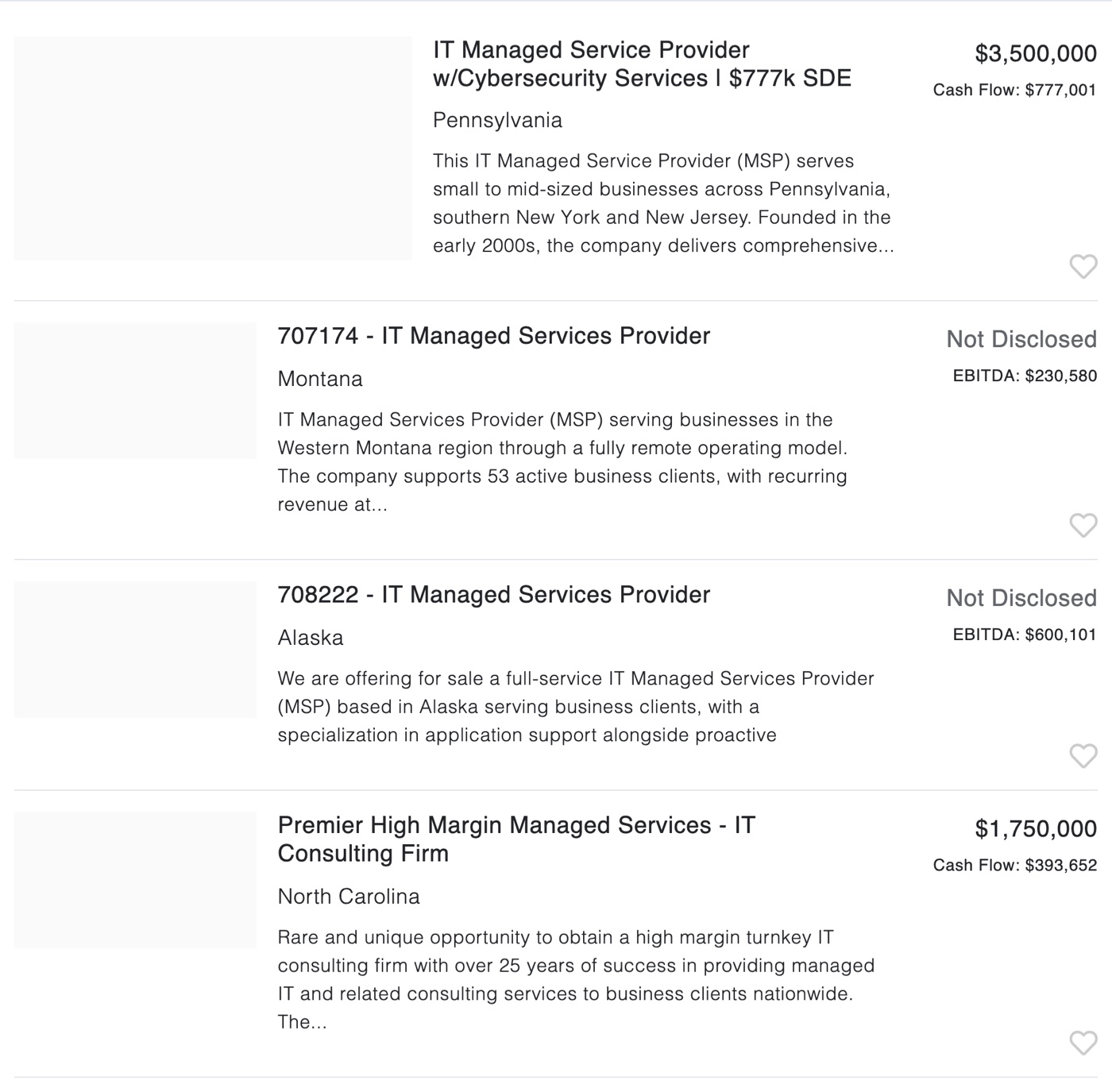 BizBuySell listings for four managed IT services businesses for sale, each showing an asking price, cash flow or EBITDA figure.
Two things to know before you compare. Asking prices aren't sale prices, and sellers list high. Cash flow on these sites usually adds the owner's pay back in, so it reads bigger than the EBITDA a buyer will calculate.
Open a single listing and look at the details section. That's where a buyer checks how much revenue repeats, how long clients have stayed, and whether the owner still does all the selling. If your company were listed, those lines would carry your price.
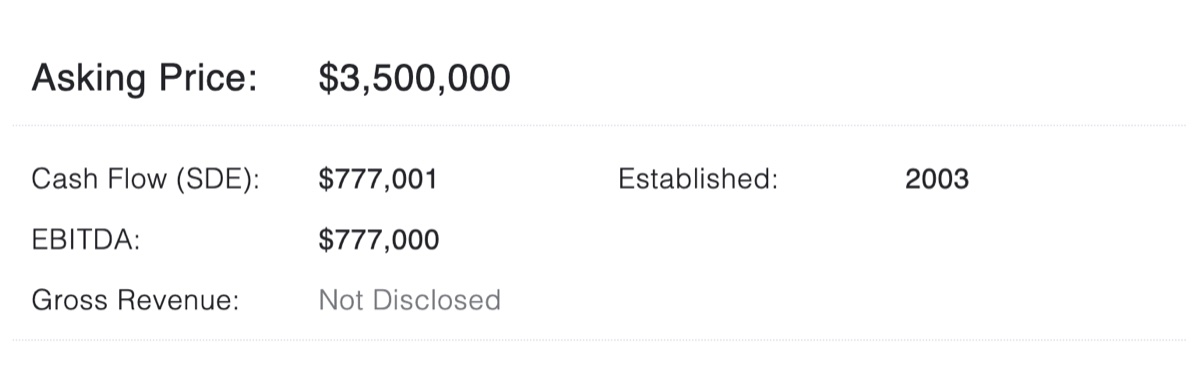 The financial summary of one BizBuySell listing for a managed IT services provider, showing asking price, cash flow, EBITDA and gross revenue.
What moves your number
Most of the levers are things you can start on this quarter.
- Move break-fix and project clients onto monthly agreements.
- Rent hardware instead of selling it. Firewalls, servers and access points can all live on the monthly bill.
- Pay yourself a market salary on paper, so your EBITDA holds up when a buyer recalculates it.
- Add clients until no single account carries the business.
- Write down how you sell, so new revenue doesn't depend on you showing up.
None of this sets your real number. A broker or M&A advisor does that, with your books in front of them. What you control is what they find when they open the books.
Every item on that list gets easier with a steady flow of new recurring clients. That's the part we handle. Helpdesk Harry books sales meetings with business decision makers straight onto your calendar, and you pay only when they show up. Meetings, not leads. See how Helpdesk Harry fills your calendar.