

MSP marketing that keeps working is a written system, not a string of campaigns. Write down who you sell to, pick a few channels, give each one a weekly cadence, and measure every stage of the funnel for a full year before you judge it. Referrals alone won't carry you past a certain size.
Most MSPs grow on referrals at first. A happy client tells a friend, the friend signs, and nobody has to think about marketing for a few years.
Then it stops. Terry Hedden put it plainly on All Things MSP. Once you get to 50, 100 or 500 customers, it's hard to keep a reliable word-of-mouth funnel, because you've put your growth in the hands of people who don't care about it (Wb9TMqwGKNY at 35:55).
So owners start running campaigns. A burst of Google Ads. A LinkedIn push. A mailer. Each one gets a few months, nothing obvious happens, and it gets dropped. The system below replaces that cycle.
Why referrals and campaigns both stall
Referrals depend on timing you don't control. Only about 3% of a market is actively looking for a new provider at any moment (PngaPDFVTp0 at 4:37). A referral only lands if a client happens to know someone in that 3% that month.
The result shows up in pipelines. Of 1,700+ MSPs surveyed, more than 75% go on fewer than two qualified appointments a month (co1EctyZXuU at 16:36).
Campaigns fail for a different reason. They get judged too early. At Altech, it took 13 months of steady marketing before a $5,000 MRR contract came in that paid for everything spent up to that point. After that the deals kept coming (XaY5PQtnxIw at 11:23). The same team spent about $3,000 a month for five months before their Facebook ads worked, and nearly turned them off (XaY5PQtnxIw at 21:45).
Most campaigns get cut long before month 13. Right before they would have paid.
Write down who you sell to
A system starts with one page that says who the buyer is. Industry, headcount, location, and what makes them switch.
The warmest buyers are businesses already paying an IT company. They have the budget and the habit. They just need a reason to move, and a generic promise of good IT support isn't one (32CHAHprsM4 at 3:38).
So name the trigger. A cyber insurance renewal that asks hard questions. A compliance audit. A second ransomware scare at the dental office down the street. Your messaging comes from that page, and so does every channel choice after it.
Pick a few channels and give them a cadence
Every channel works for someone. Cold calling, email, events, ads, direct mail, SEO. After analyzing 4,000+ MSP marketing videos, the pattern we see isn't that one channel wins. It's that the MSPs who commit to a few channels for a year beat the ones who try everything for a month.
The Altech team said this about their own 13 months. They ran the whole marketing mix and were spread too thin (XaY5PQtnxIw at 8:20). Start with fewer.
Pick from the four buckets. Outbound, content, paid ads, and referral partners. Then set a schedule you can actually keep, and write it down.
Cadence matters more than any single touch. Robin Robins teaches a sequence that pairs one memorable direct mail piece with three to four phone calls, a personal email after each call, and a one-to-one LinkedIn message (AzwyhA1ydpg at 9:21). One MSP owner who cold calls found that skipping even a Friday hurt the following week. His calling was booking around 8 appointments a month (XaY5PQtnxIw at 17:03).
You can see who commits by looking at who keeps advertising.
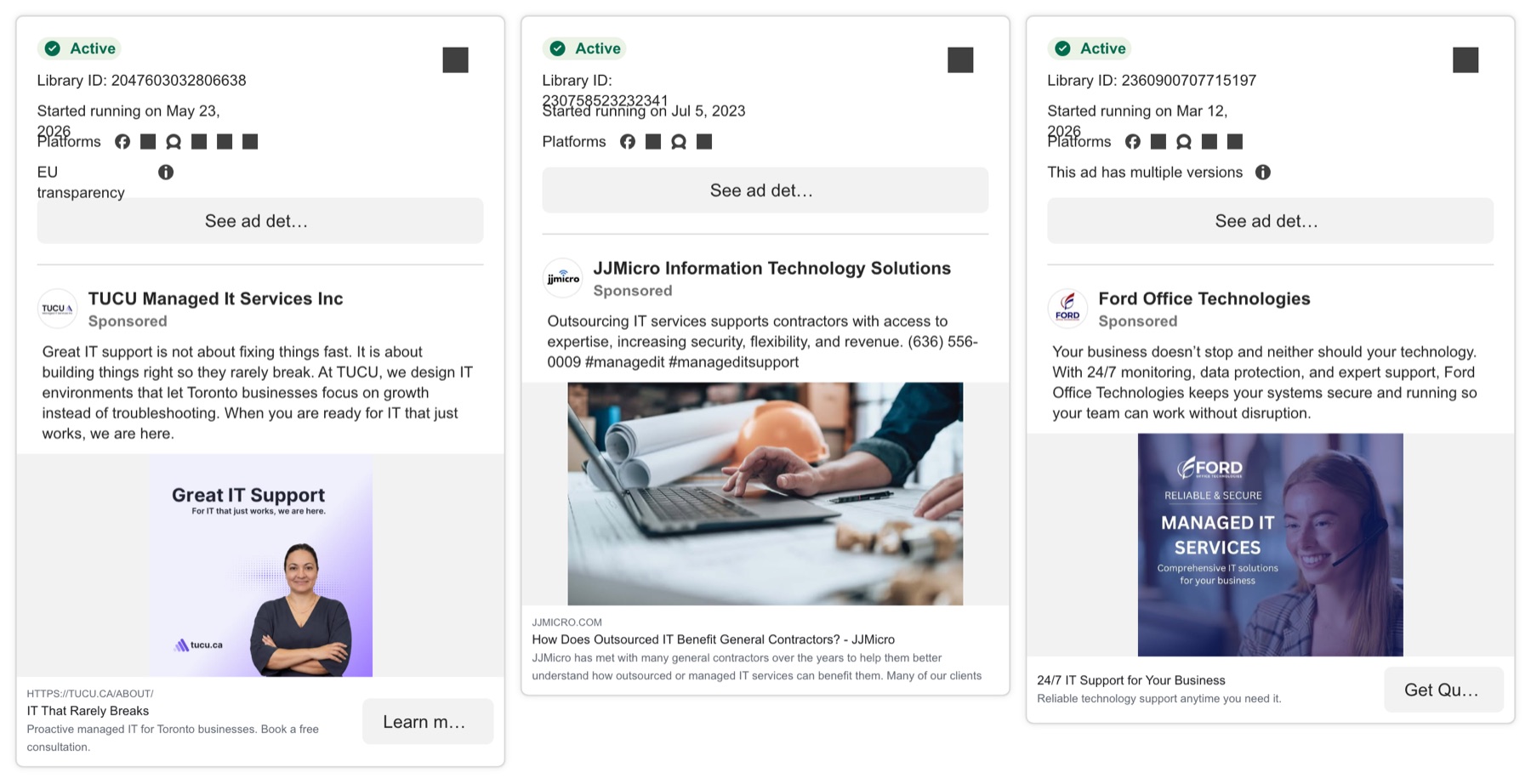 Three active ads from IT companies in Meta's Ad Library, each showing the date it started running. One has been running since July 2023.
One of those ads has been running since July 2023. That's what a system looks like from the outside. Same offer, same audience, still on.
Own the list, not just the audience
Followers on LinkedIn or Facebook are rented. An email list is yours, and it keeps working through a buying cycle that can run years.
Most MSPs underuse it. Paul Green says the most common worry he hears is that owners don't want to send more than one email a month because people will get sick of them (bTLqv9GPFpc at 1:30). A useful weekly email doesn't annoy anyone. It keeps you in front of the 97% who aren't looking yet (PngaPDFVTp0 at 4:37), so you're the name they remember when they are.
Search works the same way. When a referral doesn't come, the buyer types your service and city into Google.
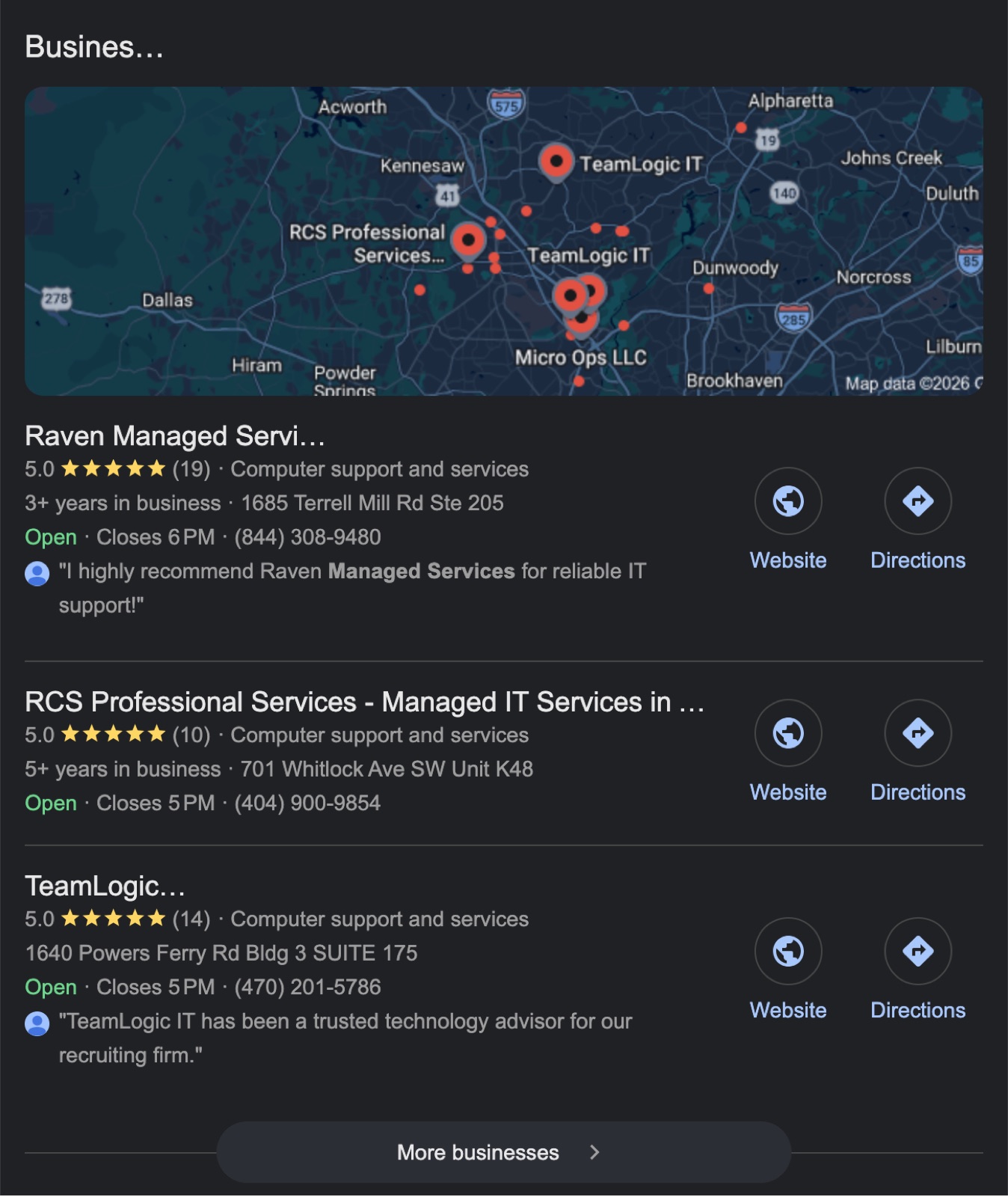 Google results for "managed it services marietta ga" showing the map pack with three IT companies, their star ratings and their review counts.
The companies in that map pack didn't get there with one campaign. They got there with reviews, a profile that's kept current, and a site that loads fast on a phone.
Measure the funnel, not the feeling
A system you can't measure turns into a campaign again the first bad month.
Track every stage. Leads, qualified leads, booked meetings, proposals, closes, and client lifetime value (32CHAHprsM4 at 4:10). Put all of it in one CRM. When growth slows, the numbers tell you whether the problem is traffic, conversion, or the sales call.
Watch the leading signals too. At Altech, email open rates and site analytics were climbing months before the leads showed up, and that's what kept the team going (XaY5PQtnxIw at 9:51).
Here's the system on one page.
- Write the buyer down. Industry, size, location, trigger.
- Pick a few channels from outbound, content, ads, and partners.
- Set a weekly cadence and put it on the calendar.
- Send a useful email every week to a list you own.
- Track every funnel stage in one CRM.
- Give it 12 months before you judge it.
Where we fit
Building the system is your job. Filling the calendar while it ramps up can be ours.
We book sales meetings with decision makers straight onto your calendar, matched to the industries and company sizes you serve. You pay only when they show up. Meetings, not leads. See how it works for MSPs.