

SEO for MSPs starts on Google Maps, not the homepage. Local buyers find IT companies in the map pack, so fix your Google Business Profile first, earn reviews steadily, then build a page for each service and town you serve. Expect months before any of it pays, and make sure the site turns visitors into calls.
Most MSP owners hear "SEO" and think about the homepage. Rank the site, get the calls. That isn't where most inbound IT leads start.
They start on Google Maps. A business owner searches "IT support near me" and Google shows a map with a few companies under it. For a local MSP, that box is the front door. Your website is the room behind it.
So the plan runs in a different order than most agencies sell it.
The map pack is where the calls come from
After analyzing 4,000+ MSP marketing videos, this was the point the most channels agreed on. One agency that runs local campaigns for MSPs says Google Maps generates 60 to 80% of all lead flow for a local MSP. Its own business gets 60% of its leads directly from Maps and another 25% indirectly. Those are a vendor's numbers. The direction is still hard to argue with.
The map pack usually shows three businesses. If you aren't one of them, most searchers never scroll far enough to find you. And they decide right there, on rating, review count and photos, before they ever open a website.
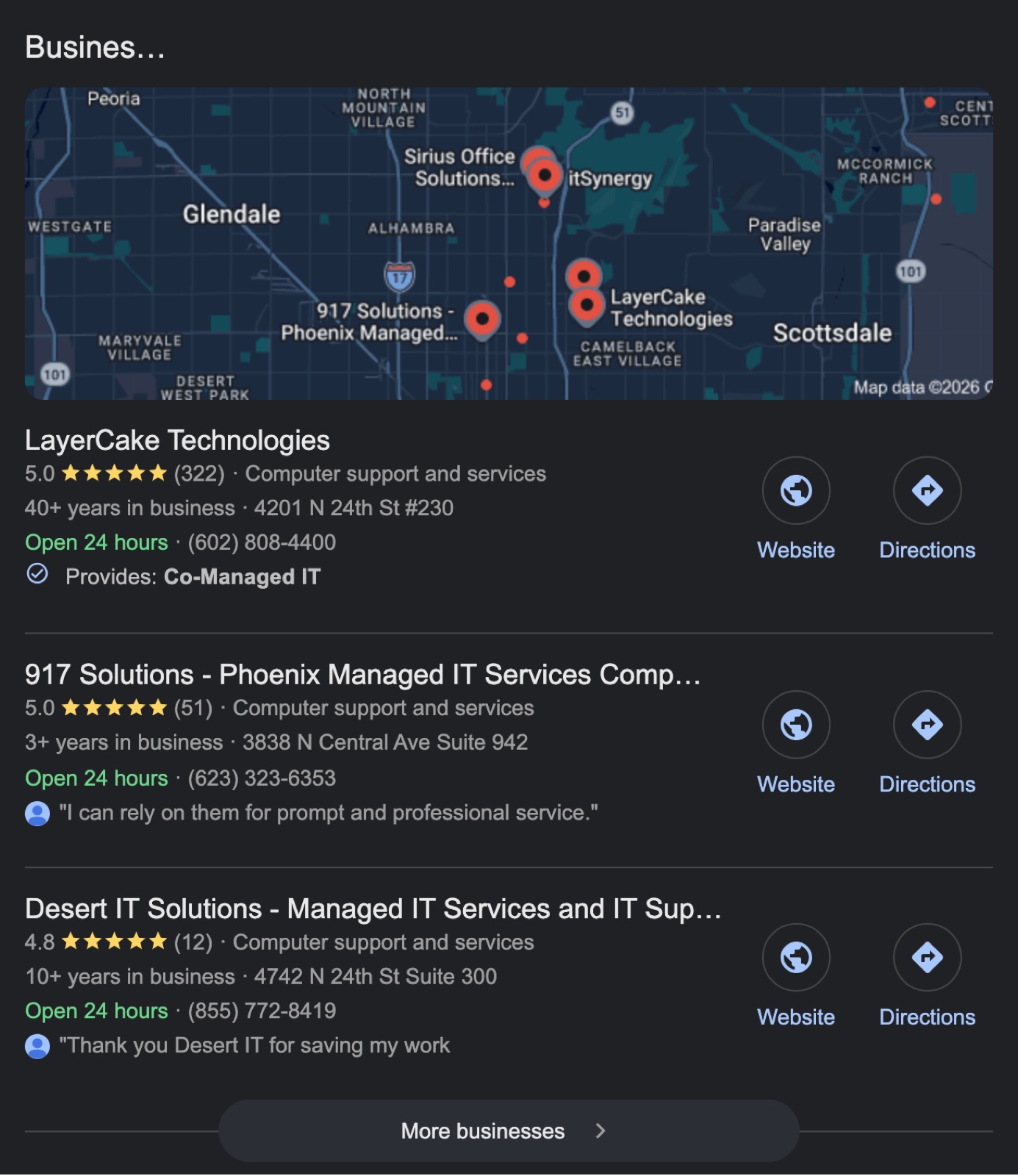 Google results for "managed it services phoenix" showing the map pack, with three Phoenix IT companies listed under a map along with their star ratings and review counts.
Look at what a buyer sees in that box. A name, a star rating, a review count, a few photos, a distance. That is the whole first impression.
Fix the Google Business Profile first
The profile is free, and most MSPs set it up once and never touch it again. These are the misses that come up again and again.
- Check the primary category. It should describe IT services, not computer repair or a software vendor.
- Widen the service area. A Google Business Profile defaults to about half a mile, or 800 meters. Set it to the area you actually cover.
- Rewrite the services list in the words a buyer types. "IT support" and "outsourced IT," not "managed services stack."
- Link each service to the matching page on your site.
- Replace stock photos with real ones. Your team, your office, a rack you built.
- Post updates and new photos on a regular schedule, and review the whole profile once a month.
None of this costs money. Local SEO is the one channel worth setting up on day one, even with no budget, because it compounds.
Reviews decide who gets the call
Reviews help you rank, and they decide which of the three listings gets clicked. One lead gen agency tells MSPs to hold a rating above 4.7 before paying for any map placement ads.
Make asking a habit, not a campaign. Send the request when a ticket closes on a good note, and again when a project wraps. Ask clients to mention the service and their town in the review, because Google reads the text.
Never offer anything in exchange for a positive review. The FTC's 2024 rule on reviews and testimonials (16 CFR Part 465) bans it, and a burst of overnight five-star reviews looks exactly like what it is.
Build a page for each service and each town
The map pack wins the "near me" search. Your site wins the searches the map doesn't cover. The town 20 minutes away. The law firm looking for an IT company that knows legal software.
That takes separate pages, each titled for one service and one place. One SEO coach walks through a competitor that ranks for "Charlotte IT company" with a single page built around that phrase. He then searches "MSP for lawyers" and finds the pages ranking for it thin and beatable.
A page for "IT support in Tempe" competes with far fewer pages than your homepage does for "managed IT services." The buyer searching it is also closer to picking up the phone.
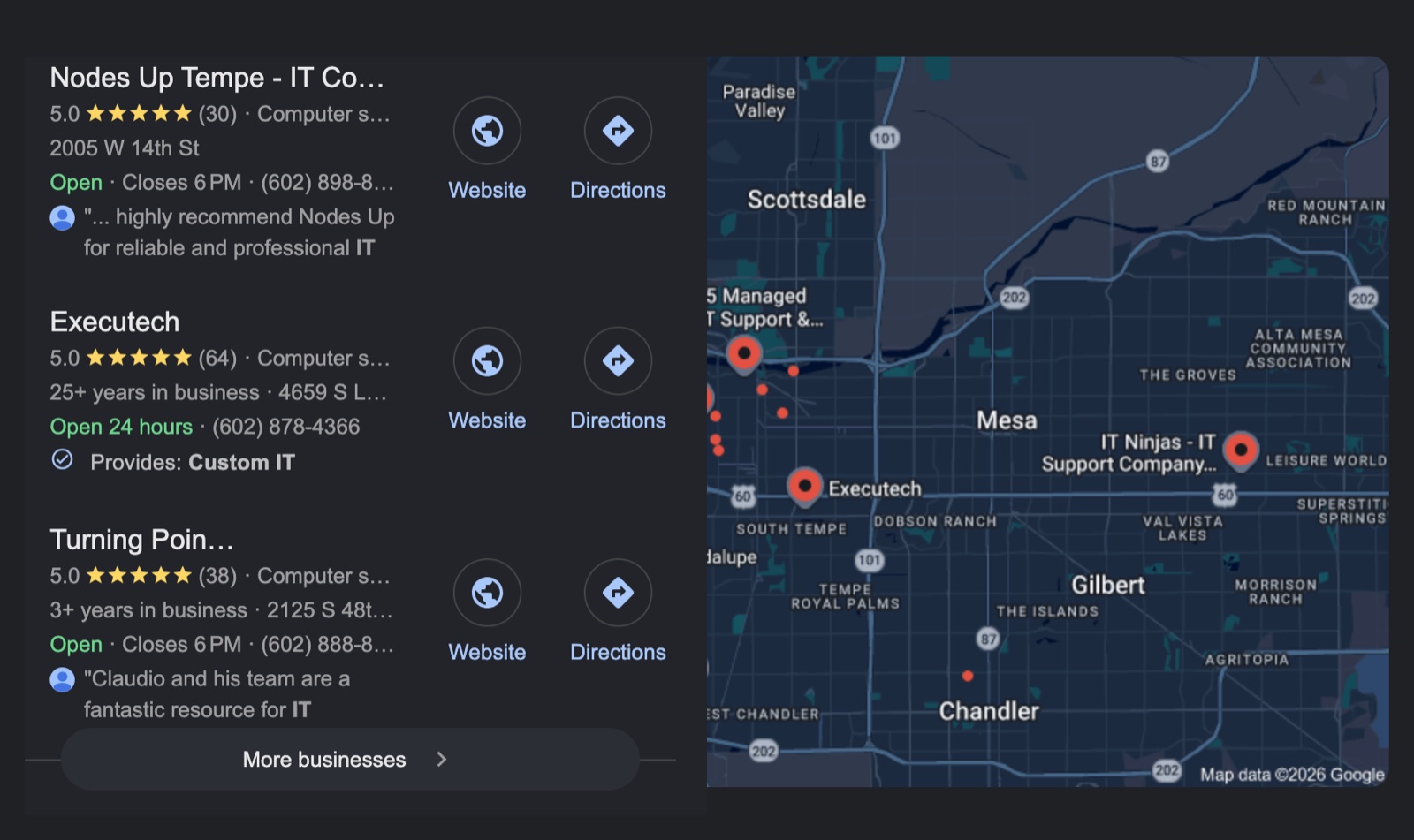 Google results for "it support tempe az" showing a different three companies in the map pack than the Phoenix search, led by one with Tempe in its business name.
Write each page for the buyer, not the search engine. Name local clients if they've agreed to it. Show certifications and testimonials. Say which towns you drive to. And only build pages for places you can serve on site, because a lead you can't reach is worse than no lead.
Expect months, and make sure the site converts
SEO is slow. The same coach tells MSPs to let a new page sit for 3 to 6 months, sometimes a full year, before changing it. Rankings drift for weeks. Leave them alone.
Traffic also means nothing if the site doesn't convert. Most IT services websites convert less than 1% of visitors into a call or a form. One MSP marketer estimates 80% of MSPs aren't in a position to benefit from SEO yet, because the website isn't right.
There's one more exception. If your office sits somewhere with few businesses nearby, SEO may never pay. Put outbound first.
For everyone else, this is the order.
- Verify and fix the Google Business Profile.
- Start asking for reviews after every closed ticket and finished project.
- Call your own number and fill out your own form. Fix the site until a visitor knows what to do next.
- Build a page for each town you serve and each industry you know.
- Give new pages three months before you judge them.
When you need meetings sooner
SEO is worth building. It also takes months to pay for most MSPs. Our model is Meetings, not leads. We book sales meetings with decision makers straight onto your calendar, and you pay only when they show. See how Meetings, not leads works.